Books |
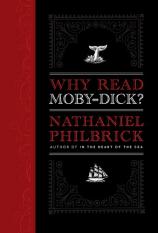
Why Read Moby-Dick?
Nathaniel Philbrick

By
Published: Nov 10, 2011
Category:
Non Fiction
I’ve never read “Moby-Dick.”
For that matter, I’ve only read one plot of “Middlemarch” — and I was an English major who graduated with high honors.
Seems like my resistance to long books started young.
So I take consolation in the confession of the author of “Why Read Moby-Dick?”
In this briefest of books — 144 pages — Nathaniel Philbrick writes:
Even though I hadn’t read a word of it, I grew up hating Moby-Dick. My father was an English professor at the University of Pittsburgh with a specialty in American maritime literature, and that big, battle-scarred book came to represent everything I resented about his job: all the hours he spent in his attic study, relentlessly reading and writing, more often than not with Moby-Dick spread out before him.
In his senior year of high school, though, Philbrick settles into the uber-classic of American novels — and has a conversion experience:
The voice of Ishmael, the novel’s narrator, caught me completely by surprise. I had expected to be bored to death, but Ishmael sounded like the best friend I had not yet managed to find. Thirty-seven years later, after reading Moby-Dick cover to cover at least a dozen times, I still count Ishmael as a beloved soulmate and spiritual adviser. Not only is he funny, wise, and bighearted, he is the consummate survivor, for it is he and he alone who lives to tell about Ahab’s encounter with the White Whale.
We all know the story. Ahab, the captain of the Pequod, is haunted by the memory of the great white whale that sank his last boat and took his leg. In his determination to kill the whale, he becomes obsessed and demonic — a leader gone wrong.
“The White Whale is not a symbol,” Philbrick insists, in one of the book’s longer chapters (8 pages.) “So forget about trying to figure out what the White Whale signifies.”
A relief. And then a thrill, for Philbrick believes that Herman Melville was better than a symbol-maker — he was a kind of seer. He quotes Melville recalling the effort of writing his big book: “Some days he wrote with his lids nearly closed, fearful of opening them wide to the light…. Sometimes he blindly wrote with his eyes turned away from the paper.” That kind of possession, Philbrick argues, makes “Moby-Dick” a book for its time — and for our time. [To buy “Why Read Moby-Dick? from Amazon, click here. For the Kindle edition, click here.]
For the real subject of the novel, Philbrick says, is leadership: how a man becomes a tyrant and a demagogue. And because there is never a shortage of tyrants, “Moby-Dick” is eternally young — a novel written about crisis, it becomes freshly relevant whenever America suffers a new one. “Moby-Dick is more than the greatest American novel ever written; it is a metaphysical survival manual — the best guidebook there is for a literate man or woman facing an impenetrable unknown: the future of civilization in this storm-tossed 21st century.”
The book bounces around, covering “Moby-Dick” from many angles. The chapter titles alone are provocative: “Chowder,” “Is There a Heaven?” and “Pulling Dictatorship Out of a Hat,” for example. You may be as allergic to “Moby-Dick” as I am — there’s considerable pleasure in reading about it.
In the end, will Philbrick inspire you to read Melville’s whale of a tale? It didn’t for me. But his enthusiasm and skill make for such a good yarn that I felt as if I already had.