Books |
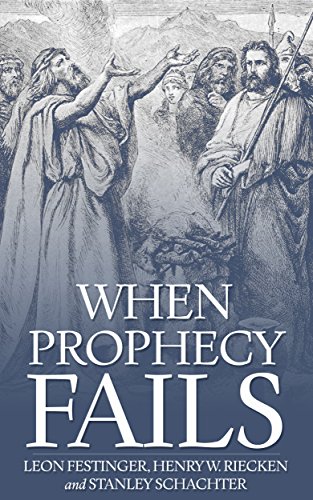
When Prophecy Fails
Leon Festinger, Henry Riecken and Stanley Schacther

By
Published: Feb 07, 2021
Category:
Non Fiction
It has surely come to your attention that there are Americans who believe improbable — no, impossible — fantasies are facts. That is why the $2.7 billion lawsuit that Smartmatic filed against Fox News, Maria Bartiromo, Jeanine Pirro, Rudolph Giuliani, and Sidney Powell begins like this: “The earth is round. Two plus two equals four. Joe Biden and Kamala Harris won the 2020 election for president and vice-president. The election was not stolen, rigged, or fixed. These are facts. They are demonstrable and irrefutable.”
The Smartmatic filing begins like that because many people don’t believe these facts. I don’t know people like that. I do knew a few people who believe that COVID is a conspiracy created to dupe the “sheeple” so Bill Gates and a few others can own the world. They are well-educated, have professional credits, go to nice restaurants and vacation spots — they’re sophisticated New Yorkers. How can you recognize them? In mask-compliant New York, they don’t wear masks. From a recent email: “It should be remembered that every study that came out BEFORE Event 201— er, I mean the pandemic — found that masks were useless and even dangerous, even for surgeons and their patients, let alone otherwise healthy people… It turns out you can’t stop viruses with a dirty diaper strapped to your face. What a mask CAN do is restrict your breathing. What it CAN do is accumulate bacteria, which are much bigger than viruses. What it CAN do is create a moist Petrie dish in your mouth and face and nose, and give you creepy respiratory diseases and sanitary conditions. And if you exercise in them, you can pass out and even die.”
You ask: Where do those ideas come from? And what could make them go away?
Eric Hoffer explored these questions in The True Believer, published in 1951. “Faith in a holy cause is to a considerable extent a substitute for the lost faith in himself,” he wrote. And the harder it is to believe, the better.
The beliefs of nuts who believe that Jewish space lasers cause forest fires and anti-maskers who aren’t convinced COVID is real reminded me of “When Prophecy Fails,” about a 1950s flying saucer cult in Chicago. Clearly, the saucers never appeared. But the cult didn’t immediately disband. Just the opposite. They believed more fervently. They gained followers. It takes “three disconfirmations” to kill a movement of true believers, the authors write, and even then some hang on. It’s a fascinating story. [To buy the paperback from Amazon, click here. For the Kindle edition, click here.]
I spent time writing about a Wisconsin saucer cult in the 1970l. I know too much about flying saucers. I’m more interested in people who think Trump is a superman — watch this video, read the piece — and he’d continue to be President by switching faces with Biden or maybe JFK Jr. How did that cult form? “When Prophecy Fails” starts with a story about a cult I’d never heard of, the Millerites. Let me quote from the book…
William Miller was a New England farmer with a belief in the literal fulfillment of biblical prophecy. In 1818, after a two-year study of the Bible, Miller reached the conclusion that the end of the world would occur in 1843.
For another five years he continued to study the Bible and to check his calculations before he acquired the confidence to talk much about it to others. Even then he talked only to his neighbors and to a few ministers, none of whom seemed to manifest much interest. He continued talking about his views, however. By 1831 he had evoked enough interest to receive invitations to address various groups. For eight years Miller continued to devote a great deal of his time to giving lectures in which he explained the basis for his prediction of the millennium in 1843. He gradually persuaded more and more people.
As 1843 approached, belief in the correctness of the predicted date grew stronger. At the same time activity in spreading the word was on the increase. The general conference had decided to hold a series of camp meetings during the summer of 1842, and these were almost all highly successful. In four months, ending the middle of November, the Millerites held thirty camp meetings at which the attendance was in the thousands. The number of adherents was growing steadily.
The official position of the leaders was that the Second Coming was expected on March 21, 1844. But that date came and went with no sign of the Second Coming.
The authors’ conclusion is not sanguine:
If more and more people can be persuaded that the system of belief is correct, then clearly it must, after all, be correct. Consider the extreme case: if everyone in the whole world believed something, there would be no question at all as to the validity of this belief. It is for this reason that we observe the increase in proselyting following disconfirmation. If the proselyting proves successful, then by gathering more adherents and effectively surrounding himself with supporters, the believer reduces dissonance to the point where he can live with it.
Here’s the most recent mail from my hard-core anti-mask, Covid-is-a-conspiracy correspondents: “The suicides in Las Vegas, the global deaths of despair, the two-fold increase in visits to the mental health service in New Zealand, the rise of domestic abuse, etc., are on yours and everyone else’s hands who have promoted lockdowns and the shutdown of in-person learning.”
Batten down the hatches!