Products |
Weekend Butler: Paul Simon builds a bridge, Hemingway wears a dress, hazelnut cocoa crème decadence, and the woman who beat the Klan
By
Published: Apr 08, 2021
Category:
Weekend
Ernest Hemingway thought it was bad luck to talk about writing: It takes off “whatever butterflies have on their wings and the arrangement of hawk’s feathers if you show it or talk about it.” A PBS documentary honors that view. It also, as is the way with many Ken Burns documentaries, never says anything once if it can say it three or four times. George Orwell wasn’t above talking about writing. “Prose like a windowpane,” he said. Magic words. I followed that principle all week, with some success. I commend it. And these things…
THE PEOPLE V. THE KLAN: CNN, SUNDAY, 9 PM.
In 1987, my living room could not have been more minimally furnished. A desk. A chair. A wall of books. Only a few items of visual interest sat on the mantel of my fake fireplace. Among them was a postcard of a 19-year-old African American boy. His name was Michael Donald, and he was hanging from a tree limb in Mobile, Alabama.
That postcard had arrived in an audacious request for funds from Morris Dees, founder of the Southern Poverty Law Center. I have no idea why I displayed that photo of Michael Donald’s lynching or why I kept it there —- every time I looked at it, I had to turn away. It took me months to realize that the post card was actionable. I was supposed to do something about it.
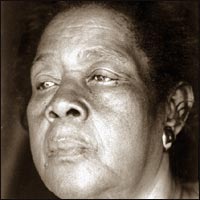
That summer I went to Alabama to interview Morris Dees, prosecutors, and Beulah Mae Donald (Michael Donald’s mother, in a photo (above) by Gilles Peress, the great Magnum photographer. On November 1, 1987, “The Woman Who Beat the Klan” was the cover story of The New York Times Magazine. As I was the only journalist to interview Mrs. Donald at length, I imagine the story I tell here is one of the foundations of the CNN series. Click here to read it.
PAUL SIMON BUILDS A BRIDGE
A 10-minute master class in songwriting. 1970, on the Dick Cavett Show, Paul Simon explains how he took bits of classical music and gospel to assemble the melody of “Bridge Over Troubled Water.”
PAPADOPOULOS CAPRICE WAFER ROLL
Not quite divine decadence, but definitely in the suburbs of decadent snacks. The wafer rolls are filled with hazelnut cocoa crème. Four rolls will set you back 150 calories. Excellent with vanilla ice cream or coffee. [To buy 2 8.8 ounce cans for $13 from Amazon, click here.]
ERNEST HEMINGWAY DOESN’T WEAR THE PANTS
Ken Burns and Lynn Novick’s three-part documentary about Ernest Hemingway on PBS is more about the man than his work, which makes sense — many more people know the legend than the complicated, contradictory facts of his masculinity. In The New Yorker, Hilton Als neatly summarizes the childhood history: “It amused Hemingway’s mother to pretend that Ernest and Marcelline, the sister closest to him in age, were twins. Sometimes she dressed them as boys, sometimes as girls. She had their hair cut in the same style—blunt bobs with bangs—and encouraged them to play with both tea sets and air rifles.”
One of his books draws on that experience. He worked on “The Garden of Eden” for more than 15 years, writing some 200,000 words in the process. It’s a love story, kind of. David Bourne and his wife Catherine are living in France. They’re young. He’s writing a book. And they want to play. The game is erotic. They cut their hair the same way, they play with sex toys, they bring another woman into their marriage. After Hemingway’s death, his publisher cobbled 280 pages together and engineered a bestseller. It’s mostly a mess — there are long passages about hunting in Africa that are nothing but padding — but there are terrific scenes that put you into the action: David catching a fish in the canal, the ordering of drinks and meals. And the meals are enough to make you run to the fish market. Like this:
They were hungry for lunch and the bottle of white wine was cold and they drank it as they ate the celery remoulade and the small radishes and the home pickled mushrooms from the big glass jar. The bass was grilled and the grill marks showed on the silver skin and the butter melted on the hot plate. There was sliced lemon to press on the bass and fresh bread from the bakery and the wine cooled their tongues of the heat of the fried potatoes….
[To buy the paperback of “The Garden of Eden” from Amazon, click here. For the Kindle edition, click here.]
SMART THINKING ABOUT WALKING
The Times recently reported on a yearlong study of a mild cognitive impairment and exercise in middle-aged and older people. The findings aren’t surprising: the people in the study raised their cognitive scores after they started walking frequently.
Rong Zhang, a neurology professor at UT Southwestern Medical Center, oversaw the new study. He believes the group’s findings serve as a useful reminder that moving changes minds. “Park farther away” when you shop or commute, he says. “Take the stairs,” and try to get your heart rate up when you exercise. Doing so, he says, may help to protect your lifelong ability to remember and think.
What to wear? Allbirds. They make a difference. For me, and for several dozen readers who have written to tell me. So, once more, walk your fingers to my report.
A POST-EASTER POEM
“Goodtime Jesus” by James Tate
Jesus got up one day a little later than usual. He had been dream-
ing so deep there was nothing left in his head. What was it?
A nightmare, dead bodies walking all around him, eyes rolled
back, skin falling off. But he wasn’t afraid of that. It was a beau-
tiful day. How ’bout some coffee? Don’t mind if I do. Take a little
ride on my donkey, I love that donkey. Hell, I love everybody.
[To buy James Tate’s “Selected Poems” from Amazon, click here.]