Products |
Weekend Butler: A totally relevant comedy to stream. Asking for a friend: do you know this woman? Avoid Andy Warhol. A complicated love story. And more.

By
Published: Mar 10, 2022
Category:
Weekend
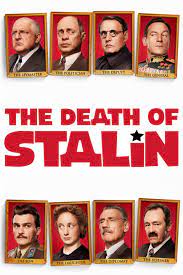
WEEKEND MOVIE: “THE DEATH OF STALIN”
This would be the ideal weekend to stream a movie about Russia. A 2017 movie that was playing to sold-out crowds in Moscow before it was banned. A comedy, even. Well, a very dark comedy, with a flawless cast.
It begins with music. In 1953, a Moscow orchestra performs a Mozart piano concerto. Stalin has been listening to the radio broadcast. He calls, requesting a copy of the performance. There is none – the orchestra must restage the performance. The conductor has knocked himself unconscious. The soloist hates Stalin and refuses. A replacement conductor arrives, in pajamas. The pianist complies. Stalin gets the recording.
Funny, and not. The real transaction here is what drives every minute of life in Stalin’s Russia: fear. From the Times review:
The fear is so overwhelming, so deeply embedded in everyday life that it distorts ordinary expression, utterances, gestures and bodies. It has turned faces into masks (alternately tragic and comic), people into caricatures, death into a punch line.
So what’s funny? No Russian accents. Everyone is constantly plotting. The actors don’t look like the historical figures they’re representing — you’ll do a spit-take when you first see Steve Buscemi as Nikita Khrushchev. The director is the incomparable cut-up, Armando Iannucci. (“For me, it’s a tremendous compliment when Russians who have seen the film say to me, ‘Where in Moscow did you film this?’ And I say, ‘In London.’”) And… the dialogue. Again, from the Times:
The laughs come in jolts and waves in “The Death of Stalin,” delivered in a brilliantly arranged mix of savage one-liners, lacerating dialogue and perfectly timed slapstick that wouldn’t be out of place in a Three Stooges bit.
Click here to watch the trailer.
Click here to rent the stream.
ASKING FOR A FRIEND
A longtime friend would like a romantic partner. He signed on to two dating sites, nearly drowned in the shallows, fled. Perhaps you have some suggestions. He’s in his early 70s. He lives in Manhattan and wants to meet a woman who also lives in Manhattan. He’s accomplished, solvent, a communicator by trade, not likely to retire. I can attest that he’s in full possession of his faculties: sociable, attentive, amusing, ironic, arguably attractive. He knows this isn’t like slapping a credit card on a counter at Tiffany, but his dream partner is a 60-to-75-year-old Manhattan-based creative or creative-sympathizer, sane, solvent, more or less emotionally stable, sapio-erotic, 420-friendly or at least tolerant, interested in music (classical and WFUV), film, and books, not necessarily an athlete but not a slug, not inclined to binge on Netflix. If you’ll send email to me with a short description of this elusive female, I’ll pass it on to my friend. I’m HeadButlerNYC@AOL.com.
CONSUMER WARNING: THE ANDY WARHOL SERIES ON NETFLIX
Ryan Murphy pumps out another Netflix series, “The Andy Warhol Diaries.” Bob Colacello, who knows all, blasts it.
What they have come up with is a totally humorless, narrowly focused—through a queer lens, darkly—melodrama about Andy’s love life, or lack thereof. And so we get Andy the ultimate sad sack, pining for romance and finding only tortured relationships.
The overall gloom is not relieved by blurry re-enactments of a ghostly Warhol-like figure tottering through the overdone rooms of an imagined version of his Upper East Side town house, while maudlin lines from the diaries are intoned in a flat, A.I.-generated facsimile of his voice, devoid of the subtle modulations that in real life gave it a peculiar charm (and allowed him to indicate he meant the opposite of what he was saying).
As it happens, I know a bit about Warhol. I wrote the New York Magazine cover story the week after his death. And I wrote the text for a Random House art book, Pre-Pop Warhol.
WEEKEND READING AND VIEWING: A COMPLICATED LOVE STORY
“Jules and Jim” was a dream collaboration: Jeanne Moreau and Francois Truffaut. Her part was free-wheeling, liberated, feminist before there was a name for it. The 1962 film pulsed with life. Some critics say it’s Truffaut’s best film; many say it’s one of the best films ever made. Capsule review: “a fairy tale about the ability and the absolute failure of human beings to sustain love of others with even the best of intentions and a clear absence of traditional rules.”
Henri-Pierre Roché wrote the novel — his first — when he was 76. He’d spent his life in the avant-garde; he introduced Picasso to Gertrude Stein. His other interest was women. He married twice, but there were many, many lovers; as Truffaut writes, “He made a work of art out of his love life.” And his novel is more than a little autobiographical. It reads like a telegram. Truffaut knew he had to film it, and when he was 29, he did.
[To read about the book and movie and go right on to buy the book or stream the movie, click here.
THE BEAUTY PART
In my novel, the first 30 seconds of this song are Billy’s walk-on music at the town hall. It’s thrilling for me to see musicians feel the music with such cool intensity. See if it doesn’t get you moving, possibly dancing. For the video, click here.
HISTORY LESSON
Why was Russia such a mess in the period in “The Death of Stalin” film? In brief, because Russians didn’t know their World War II history, they admired Stalin. And Stalin used their approval to seize absolute power, which included killing or jailing anyone who spoke against. As ever, Bloodlands: Europe Between Hitler and Stalin is invaluable:
The Soviet Union defeated Nazi Germany on the eastern front in the Second World War, thereby earning Stalin the gratitude of millions and a crucial part in the establishment of the postwar order in Europe. Yet Stalin’s own record of mass murder was almost as imposing as Hitler’s. Indeed, in times of peace it was far worse. In the name of defending and modernizing the Soviet Union, Stalin oversaw the starvation of millions and the shooting of three quarters of a million people in the 1930s. Stalin killed his own citizens no less efficiently than Hitler killed the citizens of other countries. Of the fourteen million people deliberately murdered in the bloodlands between 1933 and 1945, a third belong in the Soviet account.