Products |
Weekend Butler: A Rare Gustav Klimt Show. Strangers on Cell Phones on a Train. Margaret Mead. Midnight Music. Mary Oliver. John Le Carre. Artichoke Carbonara.
By
Published: Mar 13, 2024
Category:
Weekend
I wrote a play about Matisse and knew Bonnard was his friend, but in the mental ranking that art-lovers are prone to, I didn’t consider Bonnard as Matisse’s equal, not nearly. Two years ago, at the Acquavella Gallery, I corrected that — I saw a rare show of 22 Bonnard paintings three times, one time making converts of my friend and her artist friend.
Early in November of 2022, I missed the Paul Allen auction — and the brief public viewing of masterpieces that would soon move into private collections, never to be seen again. The Times was almost breathless as it rolled through the numbers. Five paintings sold for more than $100 million. Grand total: $1.5 billion. The biggest sales: Georges Seurat’s “Les Poseuses, Ensemble (Petite version)” sold for $149 million. (See it here. To buy a poster of the painting for $12.99, click here.) Paul Cézanne’s 1888-90 Cubism precursor, “La Montagne Sainte-Victoire” ($138 million.) van Gogh’s verdant scene of Arles, “Verger avec cyprès” ($117 million). And my favorite: Gustav Klimt’s beyond gorgeous 1903 autumnal “Birch Forest” ($105 million). (To see it, click here. To buy a poster of the painting from Amazon. click here.)
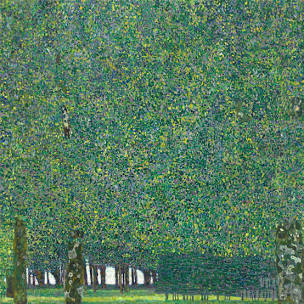
Klimt doesn’t travel much, but there’s a show of Klimt landscapes at the Neue Galerie in New York (1048 Fifth Avenue) until May 6. (Alas, my favorite Klimt, “The Park,” shown above, isn’t included, and my favorite art companion won’t be accompanying me, but the Times makes the case that this show, though small, is exceptional. [To buy a copy of “The Park” from Amazon, click here.]
STRANGERS ON A TRAIN
(from Facebook)
I’m on an Amtrak train. Business class from DC to Trenton.
There is a white man.
Southern.
Loud.
And important.
Let’s call him Chuck.
I’m about 8 rows behind him. He’s been on his cell phone since we boarded. He’s talking loud, as if he’s in his home office. Everyone else in the train car seems unbothered. But I’m annoyed.
“HERE’S MY CELL NUMBER. SEVEN ZERO THREE . . . ”
I write down his number.
I dial *67 then 1-703-….
“GIMME A SEC. GOT ANOTHER CALL COMIN’ THROUGH. YELLL-OOOO?”
I whisper. “Hello, this is Black Jesus calling. I’m riding on Northeast bound train 176. I hope y’all find the right interns for your search. You will make it to New Brunswick in time for that team meeting. I also think your pitch for the new project, with some minor adjustments, will be well received by the rest of the team. And I recommend either the Frog and the Peach or Steakhouse 85 for dinner tonight. But for right now, Imma need you to lower your voice while riding this train. In my name, Amen.”
Click.
Dude actually stood up and looked around frantically. I kept looking at my computer like I’m not Black Jesus.
MARGARET MEAD ON THE START OF CIVILIZATION
Ira Byock tells this story.
A student asked anthropologist Margaret Mead, “What is the earliest sign of civilization?” The student expected her to say a clay pot, a grinding stone, or maybe a weapon.
Mead thought for a moment, then she said, “A healed femur.”
A femur is the longest bone in the body, linking hip to knee. In societies without the benefits of modern medicine, it takes about six weeks of rest for a fractured femur to heal. A healed femur shows that someone cared for the injured person, did their hunting and gathering, stayed with them, and offered physical protection and human companionship until the injury could mend.
Mead explained that where the law of the jungle — the survival of the fittest — rules, no healed femurs are found. The first sign of civilization is compassion, seen in a healed femur.
MIDNIGHT MUSIC
A MEANINGFUL BAG
WEEKEND POEM
“I Worried” by Mary Oliver
“I worried a lot. Will the garden grow, will the rivers flow in the right direction, will the earth turn as it was taught, and if not, how shall I correct it?
Was I right, was I wrong, will I be forgiven, can I do better?
Will I ever be able to sing, even the sparrows can do it and I am, well, hopeless.
Is my eyesight fading or am I just imagining it, am I going to get rheumatism, lockjaw, dementia?
Finally I saw that worrying had come to nothing.
And gave it up. And took my old body and went out into the morning, and sang.”
WEEKEND MOVIE
JOHN LE CARRE: “THE SPY WHO CAME IN FROM THE COLD”
Graham Greene, who pretty much invented the modern spy novel, called “The Spy Who Came in from the Cold” “the best spy story I ever read.” He understood immediately that, in a decade when James Bond was all the rage, “Spy” revolutionized the spy novel. The Bond books — and, even more, the Bond movies — were thrill rides. The suave hero never mussed his tux. He had no need to; his car had more armament than one of Patton’s brigades. The explosions that went off just a few feet from him always were just background flash. And, of course, he possessed the ultimate weapon — his deadly quips, capable of killing any villain within earshot.
For Le Carré, spycraft was the antithesis of a glamour profession. It was thinking and planning, waiting and watching, and lying — always lying. It operated by a single moral law: results. You may be assured that good people were betrayed along the way.
“Spy” was an instant classic precisely because Le Carré showed readers exactly what Intelligence is about — sometimes a roll of film, more often a list of names, never a bomb in a briefcase. Even better, it revealed how the trick is done. And, most of all, it asked a question: Us and Them — how different are we, really? [To buy the paperback from Amazon, click here. For the Kindle edition, click here. To screen the film from Amazon Prime, click here.]
WEEKEND DOCUMENTARY: “REVEALING MR. MAUGHAM”
The best documentary I’ve seen in years was made in 2012 about a man who died in 1965. In 83 minutes, I learned a great deal I didn’t know about one of my favorite writers. Especially this: how did this lonely boy with a stammer grow up to becomes the world’s richest and most successful writer, tossing off bestsellers that never repeated a theme or a plot? You’ll find the answers in “Revealing Mr. Maugham.” It’s streaming on Amazon Prime.
WEEKEND RECIPE
Artichoke Carbonara
From The Times: Like most traditional Italian dishes, pasta alla carbonara, quintessentially Roman, employs a minimum of simple ingredients to create a hearty and delicious meal. Guanciale provides salt and fat, while Pecorino Romano and egg yolks mixed with pasta water — a prized Italian secret — help create the velvety sauce. To truly gild the lily, consider a raw egg yolk on top of the pasta. Artichokes, a Roman favorite, come to this dish to soak up the flavors of the guanciale while melting into the pasta. The traditional pasta used in trattorias is tonnarelli, but spaghetti or bucatini are perfect substitutes.
What is guanciale (a new word for me)? Taken from the cheek of a pig, guanciale is a rich, fatty piece of meat that often gets cured before it’s used. Guanciale is mainly found in Italian pasta dishes from Umbria and Lazio. The flavor of the guanciale permeates each bite and gives the sauce an umami richness and a bit of a salty, velvety backbone.
4 servings
Kosher salt and freshly ground black pepper
1 pound spaghetti
4 ounces guanciale or pancetta
2 tablespoons extra-virgin olive oil, plus more for garnish
12 ounces frozen or canned artichoke quarters, defrosted or drained
6 large egg yolks, plus 4 yolks for an optional garnish
¼ cup freshly grated Pecorino Romano, plus more for garnish
Preparation
Bring a large pot of salted water to boil. Cook the pasta according to package instructions until al dente.
While the pasta cooks, make the sauce: Cut the guanciale into ¼-inch-thick slabs and then 1-inch-long strips. Add 2 tablespoons of olive oil to a large, deep skillet and heat over medium. Add the guanciale, reduce the heat to low and allow the guanciale to render until crisp, stirring occasionally, about 5 minutes. Remove the guanciale from the skillet and reserve. Remove 1 tablespoon of the guanciale drippings to a small bowl and set aside.
Add the artichokes to the skillet and cook until warmed, stirring carefully so they do not break apart. Stir in the cooked guanciale.
Add the egg yolks, the cheese, 1 teaspoon salt and a few grinds of pepper to the small bowl with the reserved guanciale drippings and stir until combined
Reserve 1 cup of pasta water, then, using tongs, transfer the cooked pasta to the skillet, mixing to incorporate with the artichokes and guanciale.
While whisking, slowly drizzle ¼ cup of the reserved pasta water into the egg mixture until combined.
Remove the pasta from the heat and add the egg mixture, tossing vigorously to coat. Add more reserved pasta water incrementally until the sauce is smooth and creamy.
Divide the pasta among bowls and top with more grated cheese. If desired, place a raw egg yolk on top of each pasta nest. Top with a sprinkle of salt and pepper, and a drizzle of olive oil to finish.