Books |
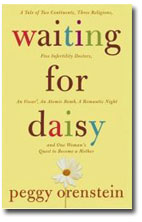
Waiting for Daisy: A Tale of Two Continents, Three Religions, Five Infertility Doctors, an Oscar, an Atomic Bomb, a Romantic Night and One Woman’s Quest to Become a Mother
Peggy Orenstein

By
Published: Jan 01, 2007
Category:
Memoir
The subtitle could make you gag from the cuteness. But Peggy Orenstein is a Contributing Writer to The New York Times Magazine, a position not easy to come by. She has written eloquently about women’s issues. And, after a series of medically-assisted efforts to have a child, she and her husband have a happy ending (or, rather, beginning) — they’re now going through life as “Daisy’s parents.”
So I forgave Peggy Orenstein that cutesy-pie subtitle and read her book.
I had another reason: In vitro fertilization is a personal interest. In 2000 and 2001, I paid for three of them. I like to say that there’s no book I can’t write in a 4,000-word piece of journalism, but my wife, Karen Collins, beat me. She told the story of our experience — with its unlikely happy ending — in a 1,500-word column in Harper’s Bazaar. I have only to glance at it to be reminded of the early-morning blood tests, daylong hormonal surges, nightly injections and the rollercoaster of hope and despair.
If you have thrown your dreams of parenthood into the chill of the laboratory, this book will bring every memory to the surface. If you are thinking about supplementing old-fashioned procreation with science, this book is a good field-guide to what lies ahead. And if you are a woman in your 30s, this book should ring like a warning bell in the night — at 37, you move into the “elderly gravid” cohort, and the chances that you’ll become a mother start to drop dramatically.
Peggy Orenstein was one of those women who kept postponing pregnancy. Her mother had married at 20, and, five years later, stopped teaching to care for her children; as her writing career heated up, Peggy was spooked by how many of her friends were making her mother’s decision. And, from her seat, the damage to their marriages was considerable: “Kids may have been the glue holding couples together, but they were also the wedge driving them apart.”
Then her husband, documentary filmmaker Stephen Okazaki, lost a close friend and his father — late in 1996, he announced he was ready to have a baby.
Six weeks later, Peggy was diagnosed with breast cancer.
Cured, Peggy dispenses with birth control. “It was if a wall between us, sheer as gossamer, had come down,” she reports. But for all the surge of love she felt, she was still divided: “On the days my writing was going well, I didn’t care if I got pregnant — I secretly hoped I wouldn’t.”
Orenstein visits an old boyfriend — now an Orthodox Jew with 15 children — and is, predictably, turned off. Nonetheless, a promise to her husband is a promise; after a year of unprotected sex and no luck, she starts taking Clomid, a fertility drug. And, predictably, finds her emotional temperature red-lining.
Now we’re in the heart of the book: the mechanized effort to conceive. “Twelve thousand dollars on a thirty per-cent chance of success” — she feels like a sucker. And like a realist: If this is the only way to conceive, well….it’s a bargain.
But nothing works. A friend visits an acupuncturist and gets pregnant; Orenstein is soon on a needles-and-herbs regimen. The only result: more strain on the marriage. “I’ll only keep trying to get pregnant,” her husband tells her, “if you stop caring.”
He’s got that right. Orenstein has the writer’s disease — she lives in her head — and so she makes the kind of mistakes you do not expect from a journalist of her stature. At a low point, she is offered a baby for adoption; she never tells her husband. She has only one ovary, and so she assumes she’s the problem; she’s very slow to wonder if her husband should be tested. And on her last IVF, she blindly agrees with her doctor’s bad advice; long before my wife’s third, she had researched the process so well she could talk with her doctors at their level.
And yet it works out. At 42, here comes Daisy. How to explain her? Luck.
Peggy Orenstein turns out to be a loving mother. She wakes up each day feeling “transcendently blessed.” She wishes she could have avoided the lesson, but she’s glad she learned it before it was too late.
The lesson? Don’t wait. In your early 30s and thinking you have loads of time? No. You don’t. The articles that make you feel good about postponing pregnancy may be true — but not for you. Unless, that is, you’re looking forward to writing a check to doctors that could have gone to school fees, child care or a summer house.
To buy “Waiting for Daisy” from Amazon.com, click here.