Books |
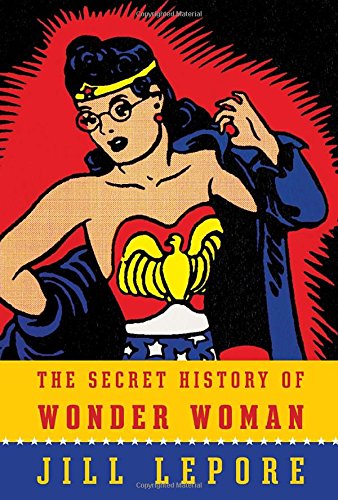
The Secret History of Wonder Woman
Jill Lepore

By
Published: Dec 02, 2014
Category:
Non Fiction
Guest Butler Tracy Edmonds Herz lives in West Virginia with her husband, three sons, and a circle of friends who share her love of Wonder Woman.
With the beauty of Aphrodite, the wisdom of Athena, the strength of Hercules and the speed of Mercury, she brings to America woman’s eternal gifts — love and wisdom! Defying the vicious intrigues of evil enemies and laughing gaily at all danger, Wonder Woman leads the invincible youth of America against the threatening forces of treachery, death, and destruction.
— Sensation Comics #3 1942
Well, Suffering Sappho! Or, if you prefer, Great Hera!
The Amazon warrior princess Wonder Woman, a minor member of the superhero contingent and an afterthought in the Justice League of America, was created as a cool cartoon pop patriot — American propaganda against the Nazis — by polymath inventor William Moulton Marston in 1941.
It turns out there is much more to the story — Wonder Woman is what Jill Lepore calls the “missing link” in the history of American feminism.
Wonder Woman, that wholesome American girl who tied up bad men and deflected bullets with magical cuffs, was also a swinging New Age potty mouth, good-naturedly cursing the goddesses when annoyed or thwarted. The inspiration for her bronze bracelets? African and Mexican jewelry worn by Marston’s student Olive Byrne, who became Wife #2 in Marston’s polyamorous household of three wives.
And that’s just the start of the revelations in “The Secret History of Wonder Woman.” Thanks to Jill Lepore, a Harvard history professor and staff writer for The New Yorker, we now know that Wonder Woman was a free love sex pistol whose inspiration was birth control pioneer Margaret Sanger and her sister Ethel Byrne.
You can’t fight for justice very easily with a passel of children hanging off your apron. Wonder Woman, Lepore tells us, came from Marston’s imagination as a direct result of the fight for reproductive rights in the bohemian 1910s. Marston family values called for erotic freedom, so it fell to Olive, the daughter of Ethel Byrne, to rear children in the polyamorous relationship.
As Lepore explains, Marston was a man with secrets who could only tell the veiled truth about himself from behind the covering of powerful, feminine women. His household arrangements were rooted in the idea — based on the philosophy of Sanger’s book “Women and the New Race” — that erotic equality was missing in the lives of women. Living in discreet but wanton abandon “with love making for all” was the family’s solution to unchaining women from bondage of domestic servitude.
Marston and Wife #1, Elizabeth Holloway, were studying for graduate degrees at Harvard and Radcliffe in 1920 when Margaret Sanger published her groundbreaking book. And the feminist cartoonist Annie Lucasta Rogers, who started a “suffrage cartoon service,” was a contemporary of Byrne and Sanger; she was a tremendous influence on the drawing of Wonder Woman. In other words, everyone in this household — and extended circles of free love feminists — had a hand in creating Wonder Woman. [To buy the hardcover from Amazon and untangle this web, click here. For the Kindle edition, click here.]
Lepore writes:
Women should rule the world, Sanger and Marston and Holloway thought, because love is stronger than force. Years later, when Marston hired a young woman named Joyce Hummel to help him write Wonder Woman, Olive Byrne gave Hummel a copy of “Woman and the New Race” Read this, she told her, and you’ll know everything you need to know about Wonder Woman.
As the women in the Marston household worked to support him, the renowned but controversial Marston pursued many ventures — including the invention of the lie detector. But it’s the sexy stuff that resonates for us. Through Wonder Woman, Marston popularized light BDSM, which he referred to as “love binding” in his Harvard experiments. It got him fired for possible “sensationalism.”
Wonder Woman was immediately and wildly popular — “the most popular superhero of all time,” Lepore suggests. One reason she’s been overlooked: She never brutally crushed an enemy. Her weapon was love. And she only bested superpowers when she wasn’t tied up — that is, when she wasn’t in an enforced pregnancy or its attendant duties. Lepore:
Picturing and talking about women chained and enslaved was ubiquitous in feminist literature, a carry-over from the nineteenth century alliance between the suffrage and abolitionist movements…
Even as the first cover girl for Ms. magazine in 1972, Wonder Woman wasn’t taken seriously. Half a century later, she’s finally headed for Hollywood. In 2016, she’s a supporting player in “Dawn of Justice: Superman Vs. Batman,” a movie about the guys. In 2017, she moves front and center, in a film directed by Michelle MacLaren, noted for episodes of “Breaking Bad” and “Walking Dead.”
If I had known you could be an American patriot and tie men up without being an outwardly compliant quasi-virgin who is regularly mistaken for a Republican, I would have been having a lot more fun for the last 25 years. Because she was wearing the American flag and our mighty eagle emblazoned on her chest, I thought she was conservative. What a cunning red herring that costume was!
As a kid, I believed Wonder Woman was real. It was just a question of when I would meet her. I had questions for her: Why are you surrounded by hapless men like Steve Trevor, who needed constant rescue? Why did you allow yourself to be abused, assaulted, insulted? Why aren’t you with Superman?
What I didn’t know in the third grade is that Wonder Woman would continue to use her gift of mental telepathy to appear at the exact right time and help us all when we need her. Or that she is an even more fabulously radical American hero now than she was when I carried her tin lunchbox. Or that, on some days, her shadow shows up in my mirror, as she might in yours.