Products |
SURVIVING THE PANDEMIC: Strutting toward the apocalypse
By
Published: May 03, 2020
Category:
Pandemic: Dispatches and Essentials
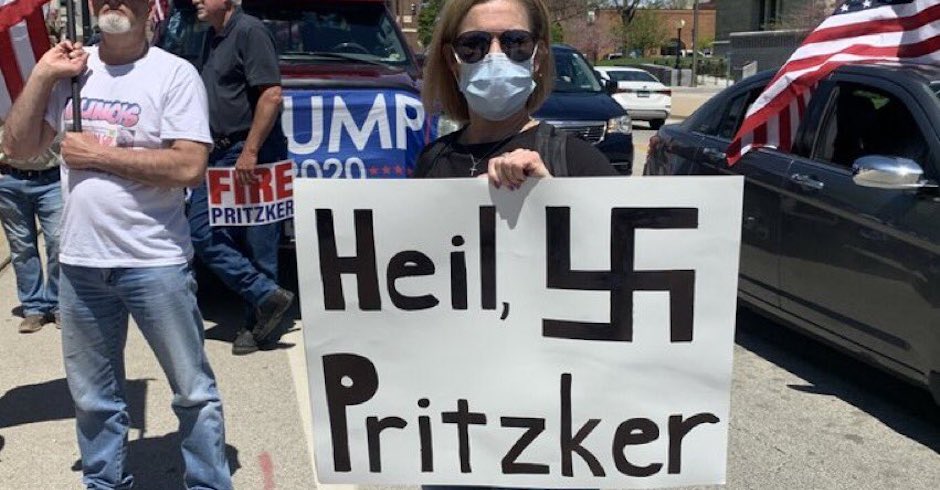
Jackie Fletcher — the woman in the photo — felt strongly about the lockdown, so she went to an open-it-up protest at the State Capitol in Springfield, Illinois on Friday. As she told her local NBC news affiliate: “I’m here to protest the loss of our rights. We’re protesting for our First Amendment and other things. Our speech isn’t really being prohibited, but our freedom is. We’re unable to leave the house and have to wear a mask.”
Jackie Fletcher is momentarily famous because she made a sign. She had written “Re-Open Illinois” on the other side of the sign, she said, because “some people get touchy about swastikas.” Like, perhaps, Gov. Pritzker. His family is Jewish and started their life in Chicago after fleeing pogroms in Kyiv.
Of no importance to Jackie Fletcher: in Illinois, 97 of 102 counties have reported cases. The state ranks fourth in the nation in total number of detected COVID-19 cases. The state had its highest number of new cases on Friday, the day the protest occurred.
It was 81 degrees in Atlanta yesterday. The streets were clogged. Social distancing — why? The worst was over.
Of no importance to the Georgians in the streets: Fulton County (Atlanta) had 1,232 new confirmed covid-19 cases yesterday, the second most ever. That’s a per capita rate 5 times New York City’s.
In Mississippi, Gov. Tate Reeves (R) announced a partial re-opening of the state on April 24. At a press conference on Friday, he was planning to announce more re-openings. He changed his mind when he learned that Mississippi had just seen 397 new cases of the virus — its largest one-day spike since his first partial rollback. As of Friday, there are 7,400 cases of the virus in Mississippi and 291 deaths.
As I reported yesterday, the incubators for the virus in our country are prisons, nursing homes, and food processing plants. The conclusion of the lecture by a respected academic: “Public health has always known the truth. The care of the most marginalized members of society is important for fighting infectious diseases.”
Seniors? No worries — they’re safe now. Last week Trump proclaimed May “Older Americans Month.”
Minorities and Jews? That’s another story. Watch Chris Rock, in a bit from 2002 or 2003 — the start of the Iraq invasion. Still relevant today:
A must-read Washington Post piece tracks 34 days of “Trump’s desperate attempts to reopen America.” It tells you, in great detail, what you surely know — Trump did nothing to get needed supplies and launch mass testing because he liked the data created just for him that showed the death rate from the virus wasn’t going to be catastrophic. Now that it’s clear that national re-opening is a stone loser of a dream, he’s gaslighting the faithful with the ludicrous notion that the current death rate marks yet another Trump triumph. Last week he made a pivot: his priority is his re-election. Tonight he’ll stage a two-hour “America Together: Returning to Work” virtual town hall — at the Lincoln Memorial!!! — to be broadcast on Fox. How many times do you think he’ll mention he’s running for President?
When you are a fool, everything comes as a surprise. If the virus hasn’t crested and a second wave hits, the first victims won’t be people Trump doesn’t care about — they’ll be the low-income, poorly insured citizens of the red states. Who voted for him. In large numbers. He’ll kill off his base.
How is that for a scenario that would create a challenging pivot for the re-election campaign: As Donald Trump struts toward the apocalypse, the South will fall again.
No gloating here — if the plague roars through the red states, it won’t stop there. You can fill in the rest of this paragraph….
This brings us to the question: Okay, Trump is a self-involved idiot who only cares about one death — his own. Why is this not obvious to his supporters?
Milton Mayer’s book — “They Thought They Were Free: The Germans, 1933-45” — has a good answer. Ignore the subject: Trump is not Hitler. I repost my review because the data — the journalism — is compelling. [To buy the paperback from Amazon, click here. For the Kindle edition, click here.] Read every word — this will be on the final exam:
In 1935, a Jewish reporter from Chicago went to Germany in the hopes of interviewing Adolph Hitler. That didn’t happen, so he traveled around the country. What he saw surprised him: Nazism wasn’t “the tyranny of a diabolical few over helpless millions” — it was a mass movement.
In 1951, the Jewish reporter from Chicago returned to Germany. This time Milton Mayer had a different goal: to interview ten Nazis so thoroughly he felt he really knew them. Only then, he believed, might he understand how it came to be that the Germans exterminated millions of their fellow citizens.
He found ten Germans. And interviewed them at such length they became his friends. Reading his daughter’s memories of her father, I can understand how that happened. “His German was awful!” wrote Julie Mayer Vogner. “And this was a great aid in the interviews he conducted: having to repeat, in simpler words, or more slowly, what they had to say made the Germans he was interviewing feel relaxed, equal to, superior to the interviewer, and this made them speak more freely.”
In 1955, Mayer published “They Thought They Were Free: The Germans, 1933-45.” It was a disturbing book then. It still is. For one thing, Mayer had only the warmest feelings for the men he interviewed:
I liked them. I couldn’t help it. Again and again, as I sat or walked with one or another of my ten [Nazi] friends, I was overcome by the same sensation that had got in the way of my newspaper reporting in Chicago years before [in the 1930s]. I liked Al Capone. I liked the way he treated his mother. He treated her better than I treated mine.
The ten interviewees were quite the diverse crew: a janitor, soldier, cabinetmaker, Party headquarters office manager, baker, bill collector, high school teacher, high school student, policeman, Labor front inspector.
“These ten men were not men of distinction,” Mayer notes. “They were not opinion makers…. In a nation of seventy million, they were the sixty-nine million plus. They were the Nazis, the little men…”
What didn’t they know, and when didn’t they know it?
They did not know before 1933 that Nazism was evil. They did not know between 1933 and 1945 that it was evil. And they do not know it now [in 1951]. None of them ever knew, or now knows, Nazism as we knew it, and know it; and they lived under it, served it, and, indeed, made it.
And none ever thought Hitler would lead them into war.
Why not?
— They had never traveled abroad.
— They didn’t talk to foreigners or read the foreign press.
— Before Hitler, most had no jobs. Now they did.
— The targets of their hatred had been stigmatized well in advance of any action against them.
— They really weren’t asked to “do” anything — just not to interfere.
— The men who burned synagogues did not live in the cities of the synagogues.
— Hitler was a father figure, right to the end. (He was “betrayed” by his subordinates.)
The more you read, the more your jaw drops. How many people did it require to take over a country? “A few hundred at the top, to plan and direct…. a few thousand to supervise and control…. a few score thousand specialists, eager to serve…a million to do the dirty work….”
There’s more, much more. Some of it is quite specific to the German character (yes, there apparently are national characteristics). And some of it might stand as universal metaphor. If you’re not a history buff, that’s the reason to read this book — it’s a revealing study of “little” people, people who seem insignificant, good citizens who do as they’re told.
Who knew nobodies could be so important — or so dangerous?
—-
To read an excerpt of “They Thought They Were Free”, click here.
Here’s a sample:
What no one seemed to notice,” said a colleague of mine, a philologist, “was the ever widening gap, after 1933, between the government and the people. Just think how very wide this gap was to begin with, here in Germany. And it became always wider. You know, it doesn’t make people close to their government to be told that this is a people’s government, a true democracy, or to be enrolled in civilian defense, or even to vote. All this has little, really nothing, to do with knowing one is governing.”
“What happened here was the gradual habituation of the people, little by little, to being governed by surprise; to receiving decisions deliberated in secret; to believing that the situation was so complicated that the government had to act on information which the people could not understand, or so dangerous that, even if the people could understand it, it could not be released because of national security. And their sense of identification with Hitler, their trust in him, made it easier to widen this gap and reassured those who would otherwise have worried about it.”
ESSENTIALS AND DISPATCHES
Everything, all in one place.
UPDATE: EO Hand Soap is available again.
UPDATE: I spoke with a NYC lung specialist. He endorses Vitamin D, but warns you not to double/triple dose. In large doses, Vitamin D becomes toxic.