Books |
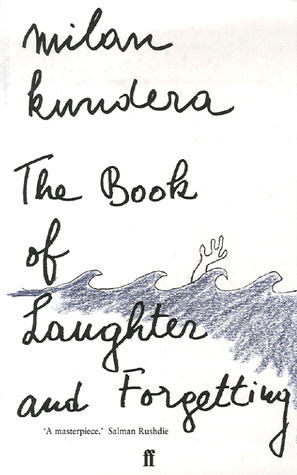
Milan Kundera: The Book of Laughter and Forgetting

By
Published: Jan 06, 2017
Category:
Fiction
In February 1948, the Communist leader Klement Gottwald stepped out on the balcony of a Baroque palace in Prague to harangue hundreds of thousands of citizens massed in Old Town Square. That was a great turning point in the history of Bohemia. A fateful moment of the kind that occurs only once or twice a millennium.
Gottwald was flanked by his comrades, with Clementis standing close to him. It was snowing and cold, and Gottwald was bareheaded. Bursting with solicitude, Clementis took off his fur hat and set it on Gottwald’s head.
The propaganda section made hundreds of thousands of copies of the photograph taken on the balcony where Gottwald, in a fur hat and surrounded by his comrades, spoke to the people. On that balcony the history of Communist Bohemia began. Every child knew that photograph, from seeing it on posters and in schoolbooks and museums.
Four years later, Clementis was charged with treason and hanged. The propaganda section immediately made him vanish from history and, of course, from all photographs. Ever since, Gottwald has been alone on the balcony. Where Clementis stood, there is only the bare palace wall. Nothing remains of Clementis but the fur hat on Gottwald’s head.
So begins Milan Kundera’s “The Book of Laughter and Forgetting.” It’s a famous passage, and if you read nothing else by Kundera… well, you’ve read this. I would encourage you to read on, but I have to tell you, I’ve read this book once each decade for three decades, and a lot of it still eludes me. I grasp that it’s about good laughter and evil laughter, about memories you want to forget and memories that are crucial to your survival. But I don’t quite get how these seven stories make a novel, or how they express in different ways how the Czechs resisted Communism, and two of the sections (“Litost,” about a rural woman’s adventure with a literary student, and “The Border,” which makes a detour into misogyny and ends with an orgy) were a chore to read.
For all that, I encourage you to read “The Book of Laughter and Forgetting” with pencil in hand, for this is the book that made Kundera’s reputation, and if you’ll just mark the sentences with ideas new to you or emotions you feel but have never quite articulated, you may agree with me that this is among the more significant books you’ve ever read. [To buy the paperback from Amazon, click here.]
First, the skinny on Milan Kundera. As a teenager, he joined the Czech Communist Party. When he saw what it was, he became a reformer, and, in 1975, a refugee. He lives in Paris now, is a French citizen and writes in French.
In this book, Kundera is writing about the l970s, but as I look back over the sentences I’ve marked, I’m stunned by how they can be read as commentary on our lives. Consider:
The struggle of man against power is the struggle of memory against forgetting.
Trying to hide, feeling guilty — that’s the beginning of the end.
The bloody massacre in Bangladesh quickly covered over the memory of the Russian invasion of Czechoslovakia, the assassination of Allende drowned out the groans of Bangladesh, the war in the Sinai Desert made people forget Allende, the Cambodian massacre made people forget Sinai, and so on and so forth until ultimately everyone lets everything be forgotten.
Women don’t look for handsome men, they look for men with beautiful women.
The only reason people want to be masters of the future is to change the past.
And this, which rang so true, I put it into my novel:
Every love relationship is based upon unwritten conventions rashly agreed upon by the lovers during the first weeks of their love. On the one hand, they are living a sort of dream; on the other, without realizing it, they are drawing up the fine print of their contracts like the most hard-nosed of lawyers. O lovers! Be wary during those perilous first days! If you serve the other party breakfast in bed, you will be obliged to continue same in perpetuity or face charges of animosity and treason!
I’ve said nothing about the characters or the stories. They are strangely compelling. An intellectual about to be arrested tries to get his love letters back. A mother comes to visit her son and his wife on the same weekend they’ve having a threesome. A widow, still faithful to her husband years after his death, wants to retrieve his memories but is thwarted. Not like “regular” stories, to be sure. You’re off-balance on every page.
Why read this book? Because we are also seeing memory obliterated and history rewritten. Because no matter how much we may want to avoid politics, we can’t. And because, as Kundera writes, “The sadder people are, the louder the speakers blare.” Sound familiar?