Books |
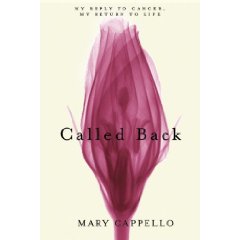
Called Back: My Reply to Cancer, My Return to Life
Mary Cappello

By
Published: Oct 06, 2009
Category:
Memoir
I have read my share of cancer memoirs, and I’m quite sure I have never encountered a woman whose reaction to the diagnosis of breast cancer — a friend’s, not even hers — is this:
I responded in that selfishly aggressive way that each of us has at least a touch of. I flung myself on the bed and bared my breasts and commanded Jean to fuck the shit out of me, to have her way with me, to do what she would with me….to return me to myself by way of the erotic.
Mary Cappello, just as an FYI, is not some attention-seeker using her gay status to shock and tease. She’s a noted author and professor of Enlish and Creative Writing at the University of Rhode Island. She knows the value of every word.
So imagine what it was like when she got the word that she had breast cancer.
First, the attention to language.
“It’s concerning,” says the ultrasound technician, explaining why Cappello needs a biopsy. A few pages later, the professor weighs in: Words…cast shadows.” And later again, she’ll ask: “What does breast cancer awareness really make anyone aware of?”
Well, in her case, it’s mostly interior, it’s about consciousness: memories of a friend who had a small lump and is now dead, considerations of the breast as a milk machine and as “a WATS line to the clitoris,” free-association to Gertrude Stein’s remark about roses, and, not least, a fierce attention to interior logic (“A person’s cancer is new to her but not new to itself”).
But not totally interior — this is also a story about radiation (“fighting fire with fire”), told with no hurry to get to the end. That sounds odd; the book is 200 pages, it’s a brisk read. What I mean — what she means — is that she wants to feel every moment, to live it fully, to drain it of meaning before moving on.
Mary Cappello is certainly the most literate woman to write about her illness. Before surgery, she reads Proust in the hospital; he doesn’t require rapt attention. Her lover’s profile reminds her of “a medieval prince.”
But don’t be fooled. She may be learned. She may be gay. But her emotions and thoughts seem universal — just a lot more accessible than we’re used to.
There’s a terrific story about a farmstand near the New England cabin that is the country retreat for Cappello and her partner. It’s adorned with American flags. The proprietor wears U.S. Marines T-shirts. Late one afternoon, he corners Cappabello and her lover. He has a question: “Was it hard to come out to your families?” And he has a reason for asking it, which I won’t spoil here, except to say — it’s hard to know, really know, about other people.
About the title: “Called back” were Emily Dickinson’s last words. And the words carved on her tombstone. For Mary Cappello, who is now cancer-free, they’re the last words on her illness. And a very powerful title for an extraordinary book.