Books |
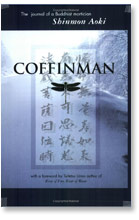
Coffinman
Shinmon Aoki

By
Published: Jan 01, 2006
Category:
Memoir
In Japan, there’s no job lower than washing corpses and putting them in coffins. This was, as Shinmon Aoki wryly tells us, not his dream job. He had dropped out of college, opened a coffee shop and pub, and soon found himself running a hangout for poets and artists. A well-known novelist encouraged him to write; he got his first story published in a classy magazine. Soon he was neglecting his business — he filed for bankruptcy as his wife was giving birth. There wasn’t even money for baby food. So when he saw a want ad — "for ceremonies to start a new life" — he jumped at the job. Only when he started work did he see the stack of coffins.
The book begins on Aoki’s first day. "There’s more to washing corpses than meets the eye," he learns. "It’s not just bathing them. You’ve got to wipe them down with alcohol, put them in their white ‘Buddha-robes,’ fix their hair and faces." And then there’s the small matter of revulsion — dead bodies force us to confront our own fear of death. "I worked frantically, frenzied, fighting off waves of nausea," he confesses.
Why am I shoving such unpleasantness your way, as if it were a gift? Because this 142-page book is unlike anything I’ve ever read. As memoir, it’s fascinating. As philosophy, it’s refreshing. As spirituality, it’s lovely and reassuring. You definitely get your money’s worth from Shinmon Aoki.
Ten pages in, and Aoki is getting beyond the horror. Driving home, he notices thousands of red dragonflies flying into the sunset. He realizes that they’ve been doing this "from the past beyond all reckoning." He looks at the fishermen trolling the river. "The salmon, too, in this one moment of autumn, were traveling upstream, fully believing in the eternal cycle of life."
Then he is called to bathe and coffin the father of an old girl friend. He had never met the man. Indeed, he’d never resolved the relationship with the woman. But now he is locked in a profound moment with her, a moment "that transcended the trivial world of scorn or pity or sympathy." It’s so much bigger: "She accepted my total existence just as I was."
From this moment, he began to feel good about himself and his work. And that opens him up more. He decides to claim a better opinion of coffinmen by wearing doctor’s clothes. He gets respect from families and priests. And now he is ready to change his view of death.
In Part II, the cases are just as unattractive. But Aoki has changed. "All I see are dead people," he explains. "And so the dead appear to me as serene, even beautiful." And so do the living. He sees a glow around people, the sparkle of the day, the glory of the world — and the insignificance of death. T
he final section of the book deals with the Buddha and with Buddhist thought. It’s a bit technical, but not esoteric. And it feels right — the coffinman’s passage is from horror of death to a deep appreciation of dying. Because the book is short and fascinating, you get there with him, and very quickly. Whether you can hold that thought is another matter. I’ll be thinking about this short book for a long time.
To buy "Coffinman" from Amazon.com, click here.