Books |
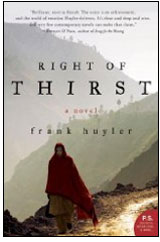
Right of Thirst
Frank Huyler

By
Published: Jan 01, 2009
Category:
Fiction
Video
Meet Frank Huyler
I read the publishers’ catalogues and sometimes even their novels, and I have the same reaction over and over: Who are these books for? They surely don’t touch me. Family dramas, love stories, thrillers, quests — somebody must care about them. To me, they take place in fictionland, a world far from the one we’re living in.
I’m not saying that novels should be as timely as a Twitter bleat. I’m just dazzled by how religiously novelists ignore the issues we actually think about, the issues that obsess us and keep us up at night. Because it’s not like what’s happening is a secret. Any writer could have felt the tectonic plates moving these last few years and wonder — just f’instance — how your life “matters” when you control so little of it. Or what happens to love when the money goes. Or how a resourceful woman deals with the loss of her access to credit cards, or how a poor person holds on to her values, or what you do to keep your spirits up when the only thing that gets you to your job in the morning is that company-paid health plan.
None of these subjects shows up in the novels that come my way, so I was unnaturally pleased to encounter Right of Thirst, which addresses a question that I, for one, think about all the time: Can one person make a difference? Here, that person is Charles Anderson, a cardiologist. In his hospital, his town, his field, he’s a somebody, but as the book begins, he feels like a cipher. And rightly so. His wife had a vague pain in her abdomen — for a year! — and he dismissed her, thinking she was “imagining things” Now she’s freshly in her grave, and he can see, with the clarity of mourning, what a second-rate husband he’d been — for three decades, he’d given his love to his career and left his wife to raise their son and paint her little portraits.
Meaning! He thirsts for it. And, right on cue, opportunity knocks — there’s been an earthquake in the Middle East, and he can do great work at a refugee camp set up on a remote mountain. No sooner can you say sabbatical than he’s off.
Of course, nothing is as promised. The refugees are nowhere to be seen. Romantic temptation is quite present, however, in the personage of Elise, a too-attractive-to-ignore German who’s studying the DNA of a mountain tribe. Charles makes a small medical miracle by amputating the leg of a girl who’d die without the operation, but he’s disillusioned:
I’d come all this way for an empty tent city and a one-legged girl. A wind-scoured field of stones on the other side of the earth…My plunge into the unknown, my step into this other world, where I hoped to lose myself in an abundance of need – and so few of my hopes had come true.
But he doesn’t get to mope for long. Fighting breaks out. And the book becomes a kind of survival epic, as the American’s illusions are stripped from him.
The author is an emergency physician. His medical writing has the feel of authenticity, and his diagnosis of human emotions is sure. He’s much traveled in the Middle East, which partly explains the title — the Prophet Muhammad laid out the rights of the thirsty for the precious resource, water.
I’ll spare you the ironic meaning of the title, and my wish that 355 pages were 300, or my slight suspicion that Hemingway is one of Frank Huyler’s literary influences. Focus on this: “Right of Thirst” is a serious novel about serious matters. It’s not a waste of your time.
To buy “Right of Thirst” from Amazon.com, click here.
To buy the Kindle edition of “Right of Thirst” from Amazon.com, click here.