Books |
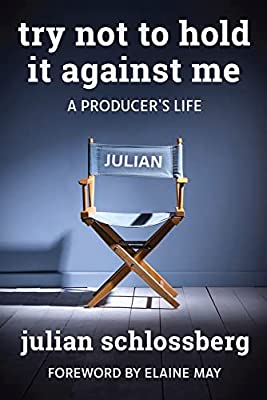
Try Not to Hold It Against Me: A Producer’s Life
Julian Schlossberg

By
Published: Jan 31, 2023
Category:
Memoir
SUPPORTING BUTLER: You can become a patron of this site, and automatically donate any amount you please — starting with $1 — each month. The service that enables this is Patreon, and to go there, just click here. Again, thank you.
GUEST BUTLER RON FRIED is a veteran TV producer (Dick Cavett, Tina Brown) and the author of three novels, most recently the excellent Frank Costello: A Novel. He is a frequent contributor to the Daily Beast.
The cast of Julian Schlossberg’s new memoir, “Try Not to Hold it Against Me: A Producer’s Life,” would make any producer’s heart soar. There’s Elaine May, Mike Nichols, Woody Allen, David Mamet, Robert Duvall, Shirley MacLaine, Warren Beatty, George C. Scott, Martin Scorsese, Barry Diller, and a young man searching for a mentor in the film business…Harvey Weinstein.
Besides the many anecdotes expertly told, the deeper subject of this memoir is how show business works, how deals work, and what exactly a producer does in theater, film, and television. This is a tough-minded — but kind-hearted — entertainment industry version of “The Art of the Deal,” written by an 81-year-old mensch who Mike Nichols called “the nicest man in show business.” [To buy the book from Amazon, click here. For the Kindle edition, click here.]
Time to roll a few of Julian Schlossberg’s credits. There’s Broadway (“The Beauty Queen of Leenane” and “Bullets Over Broadway”), Off-Broadway (“Vita & Virginia” and “Death Defying Acts”), television (“American Masters: Mike Nichols”) and film (“No Nukes”). For the full, dazzling list of credits, visit his site.
Disclosure: In the fall of 2020, Schlossberg was set to produce a play I wrote. Then Covid hit.
Schlossberg grew up as a street kid in the Bronx. By the time he was ten years old he was reading Variety and scalping tickets to live shows at the Kingsbridge Armory. As a teenager, he snuck backstage at the Latin Quarter nightclub on Broadway to catch a glimpse of the showgirls. Later, he bluffed his way into 30 Rock to watch Frank Sinatra rehearse.
In his twenties, Schlossberg began following the great director Elia Kazan on the street. Kazan finally turned and said, “Who are you, what do you want, and why are you following me?” By the time their conversation was over, Schlossberg was representing the distribution rights to two of Kazan’s classic films.
Over the years, Schlossberg ran the Walter Reade Company’s chain of eighty prestige movie theaters, hosted a nationally syndicated radio show, and spent two unpleasant years at Paramount Pictures in Hollywood where he was vice president of production.
While describing each phase of his career, Schlossberg explains the deals that make the show go on. His account of casting the Broadway production of “Sly Fox” should be read by anyone who wants to understand what really goes into any stage production, from first meeting to opening night.
Towards the end of the book, Schlossberg offers this bit of wisdom about life in show biz: “Most people are barely holding on to the ledge. After some time, they let go. If you are willing to not let go, you have a chance to make it. Of course, you need talent. But without passion and true grit, your chances are almost nil. Talent on its own isn’t enough.”
True that, as the kids say.
I spoke with Julian Schlossberg via Zoom. Here’s an edited version of our conversation.
What would you like readers to understand about what it really means to be a producer?
Today you watch a film, and it says produced by 27 people. But what a true producer does is find the property, work with the writer, hire the director, get involved with the casting, be in charge of the advertising, the marketing, the publicity. It never stops as a producer if you’re a true lead producer. I can kvetch and moan, but I love it.
One of the keys to success is your ability to negotiate and make deals—including the confidence to walk away from a project if it’s not working for you. Do you ever worry when you say “no” and turn down a potentially lucrative project?
No, because it’s not a kneejerk decision. I’ve analyzed it. And I find in life, not just in business, but also in relationships, I go back to the simple accounting: Are the assets of that person or that project more than the liabilities? When I see the liabilities adding up, as I have with a lot of actors over the years, I walk—or fire them. But it’s always well thought out.
You worked with Elia Kazan and Mike Nichols, two great directors who are among the few directors to thrive in theater and film. What qualities did they have in common?
Great intelligence, unbelievable curiosity, and a true desire to understand human behavior. They used that knowledge as directors — sometimes in a very tough way, sometimes in a manipulative way — to get what they wanted when they wanted it. I never left a meeting, a lunch, or a dinner with either of those men without my head spinning with ideas and feelings and excitement.
What is the key to communicating with performers?
Tell them the truth. They’re lied to a lot. No matter who they are, they’ve been rejected a lot. It’s a tough business, and they’re often damaged. So I always try to be supportive.
When Harvey Weinstein was a young music promoter eager to learn how to make movies, he came to you wanting to learn the business. What did you make of him back then?
He had a great sense of humor, he had great taste, he was eager to learn, he was extremely deferential. And why not? He wasn’t going to bite the hand that feeds him, and I was going to teach him the film business. There was nothing in his makeup that would lead me to believe that he would reach the heights he did or sink down to the depths. All of us have parts of us that we’d rather not show or even think about. All of us have a shadow side. Sometimes the shadow takes over, and the shadow is you, which is obviously what happened in his case.
Mike Nichols said you were the nicest person in show business. Yet your memoir shows that at times you’re also made of steel.
I have found in life that many people misinterpret kindness for weakness. I am kind, but I am strong.