Products |
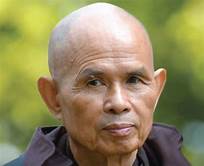
SURVIVING THE PANDEMIC: Thich Nhat Hahn on suffering: Rest your hand on his/her back
By
Published: May 07, 2020
Category:
Pandemic: Dispatches and Essentials
As a novelist, I’m a journalist. I read every relevant book about my subject, make documents with each book’s best stories and ideas, create a timeline, make a briefing book. Writing a novel becomes more about making connections and connecting the dots for me than it is about towering feats of inspiration. I remind myself: Balzac was also a kind of journalist.
I’m now making notes from a table with stacks of religious biographies on it. Buddhist biographies. As we all know, the beginning point of Buddhism is suffering, its causes and its remedies. You may say: very useful… in theory. But not well-suited to this pandemic. We didn’t choose our suffering. It chose us. And it is everywhere and inescapable. For the record, I’ve hedged the bet; I’ve just started taking a low daily dose of Celexa. But I feel I’m getting more value — and quicker relief — in my heavily underlined books by Thich Nhat Hanh.
I interviewed him, ages ago, for America Online. He doesn’t use a telephone, so I had to pick him up and drive him to the office. TNH practices “walking meditation.” That is, he walks very slowly, breathing very consciously, so that every breath and step become prayers. I knew this. And walked very slowly. But not slowly enough. Every ten paces, I had to stop and go back.
In the studio, we sat next to one another. After a few minutes, he put his hand on my back. I thought it was because I was revving too high and he wanted to calm me down. Last night, I had a different thought: He understands anxiety as pain. In that gesture, he was supporting me. Comforting me.
In that spirit, may I put Thich Nhat Hanh’s hand on your back?
In “The Heart of the Buddha’s Teaching: Transforming Suffering into Peace, Joy, and Liberation,” he writes:
Without suffering, you cannot grow… The ocean of suffering is immense, but if you turn around, you can see the land… just seeing the causes of your suffering lessens your burden.
Individual suffering is specific; the poor family a half mile away suffers in ways I hope never to experience. Most readers of these words are luckier. You are more likely to experience what a few wise people — notably Esther Perel — have noted: the stress of maintaining or nurturing a relationship during a lockdown. On the theory that this applies to many Butler readers — it certainly applies to me — that’s my focus here. TNH would approve; his writing has more practical knowledge than doctrinal analysis.
“Teachings on Love” — for my review and buy links, click here — is the most relevant of TNH’s books today. His advice is almost too simple: Be present. Listen. Respect. Encourage. This is not always pleasant: “The other person, like us, has both flowers and garbage inside.” But because we are intimate with our lover — because he/she takes us into the emotional and sexual equivalent of the Forbidden City — we have a special opportunity to live each moment fully and deeply. As he writes:
Understanding someone’s suffering is the best gift you can give another person. Understanding is love’s other name. If you don’t understand, you can’t love.
Often, we get crushes on others not because we truly love and understand them, but to distract ourselves from our suffering. When we learn to love and understand ourselves and have true compassion for ourselves, then we can truly love and understand another person.
In true love, there’s no more separation or discrimination. His happiness is your happiness. Your suffering is his suffering. You can no longer say, “That’s your problem.”
To love without knowing how to love wounds the person we love. To know how to love someone, we have to understand them. To understand, we need to listen.
I realize that you may not see much good news now and may, like me, suspect more tragedy and despair lies ahead — and there may be nothing we can do about it. But in our relationships, we are not helpless. So I’m grateful TNH reduces tasks to the basics, to what I can do: Be flexible. Pay attention. Breathe deep. Feel the day.
Even simpler: rest your hand on his/her/their back.
—-
ADDITIONAL READING
I’m also revisiting his most popular book, “Being Peace.” (For my review and buy links, click here.)
To buy “The Heart of the Buddha’s Teaching: Transforming Suffering into Peace, Joy, and Liberation” from Amazon, click here.
—-
ESSENTIALS AND DISPATCHES
Everything, all in one place.
UPDATE: I spoke with a NYC lung specialist. He endorses Vitamin D, but warns you not to double/triple dose. In large doses, Vitamin D becomes toxic.